
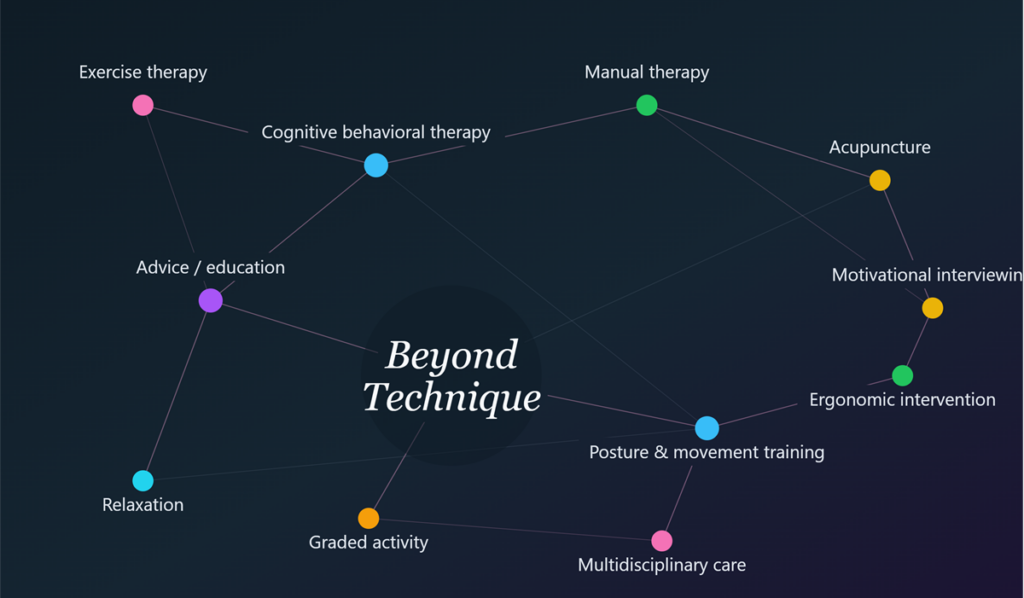
A recent paper in the European Spine Journal brought together 29 of the top experts in their field from across the LBP treatment landscape — chiropractors, spine surgeons, physical therapists, basic scientists, psychologists — and asked each of them to map their understanding of how treatments work.
Not which treatment is best. How they work. The mechanisms.
Using fuzzy cognitive modeling, the researchers (Cholewicki et al., 2026) pooled 142 treatment-relevant components and 1,161 weighted connections into a single meta-model representing collective expert knowledge. They then ran simulations to rank treatment effectiveness and identify the mediators — the intermediate pathways through which each treatment produces its effects.
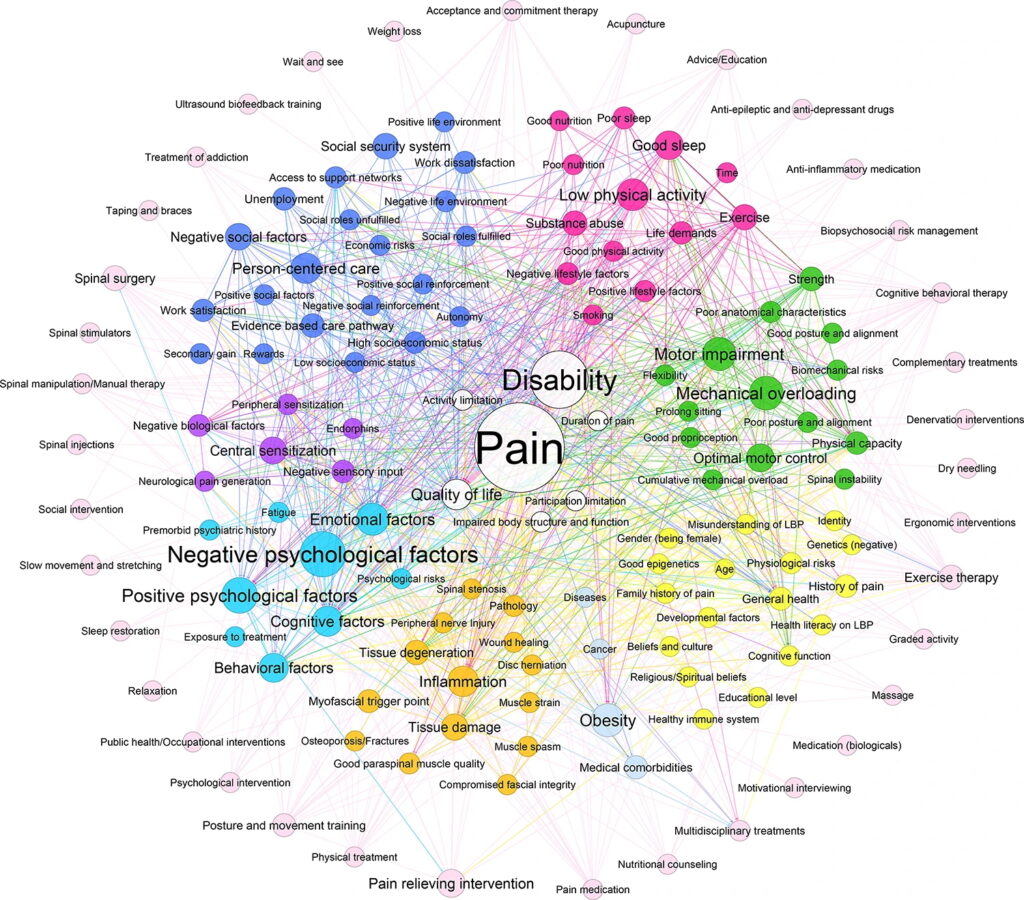
Source: Figure 2 from Cholewicki et al., European Spine Journal, 2026
Open access — reproduce with citation below Figure from Cholewicki et al., European Spine Journal, 2026 (doi: 10.1007/s00586-026-09932-y). The meta-model maps collective expert knowledge of LBP: 142 components, 1,161 weighted connections. Circle size = centrality; colors = ICF domain.
Note “Spinal manipulation / Manual therapy” at left periphery; “Posture and movement training” at bottom; Pain and Disability outcomes at center.
The finding that made headlines, and was widely predicted: cognitive behavioral therapy (CBT) ranked #1 across all three outcomes — pain, disability, and quality of life.
The finding buried in Part 3 is the one worth your attention.
Mediators Change Everything
For spinal manipulation, the highest-ranked mediating domain was biomechanical. Consistent with what most of us were trained to believe: adjust the spine, restore movement, reduce pain.
But the primary mediating component — the single factor with the strongest role in driving treatment effects — was this:
Reduced unhealthy expectations, beliefs, and perceptions concerning pain.
A psychological component. Of the biomechanical treatment.
The experts who modeled spinal manipulation’s mechanism said, collectively, that its primary mechanism of action is a shift in the patient’s cognitive and perceptual relationship to their pain — not the structural correction per se.
This isn’t an argument against spinal manipulation. It’s a more accurate description of what it does.
Outcomes Do Not Depend on Technique
The Cholewicki mediator finding is joined by another significant systematic review and network meta-analysis for the chiropractic profession. In 2025 Nim et al. examined 161 randomized controlled trials involving nearly 12,000 patients and asked a different but related question: does it matter how you deliver SMT — the specific target, thrust type, and spinal region? Their conclusion: largely, no. A general, nonspecific approach had the highest probability of producing the largest effects. (Nim C, et al. J Orthop Sports Phys Ther. 2025;55(2):109-122. doi: 10.2519/jospt.2025.12707)
Two independent research teams, two different methodologies, the same direction: technique specificity doesn’t drive outcomes the way we assumed.
The chiropractic section of the American Public Health Association (APHA) cited both papers when creating their infographic, “Beyond Technique: The Holistic Encounter” (PMID 39869665). Their graphic is an interpretive framework, one that names five biopsychosocial domains of clinical influence — cognitive, affective, interoceptive, behavioral, and social.
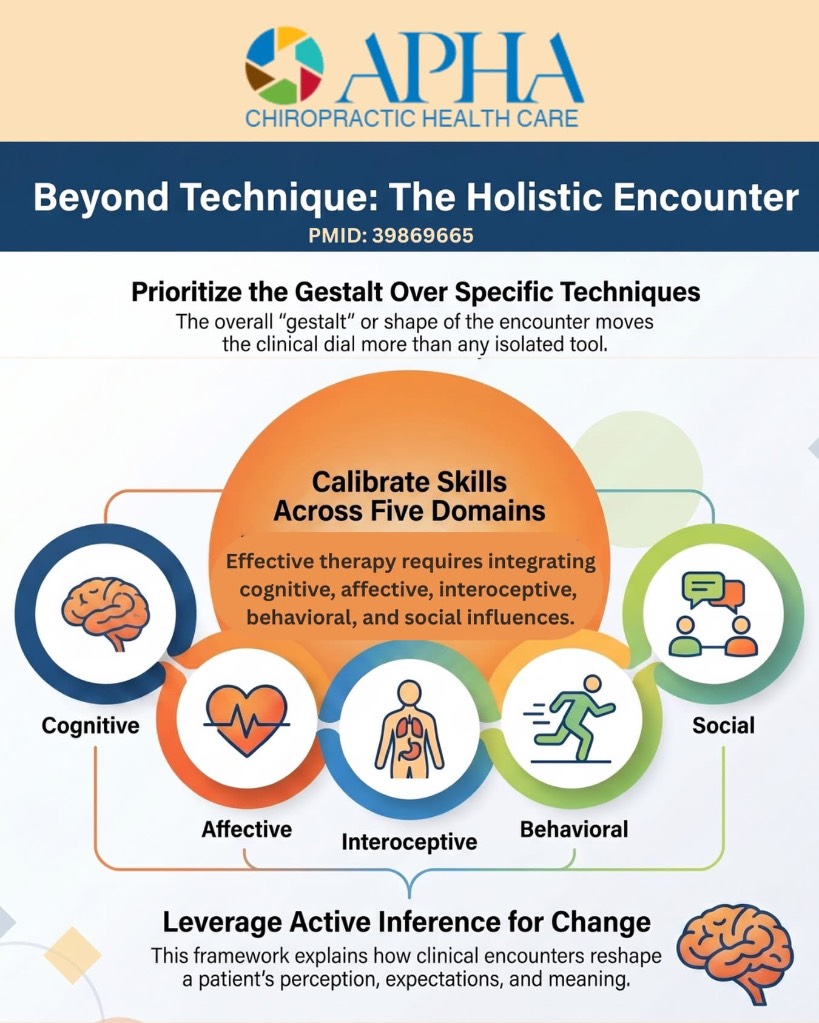
Front and center is the hidden sense that’s been guiding my professional fascination and efforts for years: INTEROCEPTION. APHA’s infographic is on target, accurately naming the research-supported BPS mechanisms… but … They’re not giving a roadmap for NMS professionals to incorporate into an already busy practice. The WHAT needs a HOW to be actionable.
One More Finding Worth Highlighting
Table 3 of the Cholewicki meta-model, without fanfare in the abstract: posture and movement training ranked #5 for pain reduction, #5 for disability, and #4 for quality of life — above spinal manipulation across all three outcome categories, in a ranking constructed by 29 leading LBP experts.
That’s not a footnote. For clinicians who integrate structured postural motor control work into their practice, this is very significant validation.
What the Research Is Pointing Toward
The pattern across these findings is consistent: what makes treatments work — including manual therapy, a structural intervention from most common perspectives — is a shift in the patient’s nervous system, one that is sensory input as much as (or possibly more than) motor output. Their expectations, their internal model of their body’s capacity, their processing and thus perception of what’s going on…and what is possible.
CBT works by targeting how the patient thinks about pain. The Cholewicki findings say spinal manipulation targets something closer to perception — how patients feel about what their body can and can’t do. Posture and movement training does it through the motor system, giving the nervous system a new felt sense of capability. The approaches differ. The underlying target doesn’t.
The unifying mechanism is what neuroscience calls the brain’s predictive model of the body — the ongoing internal representation of body state, updated through sensory experience. When a clinical intervention updates that model, outcomes improve. When it doesn’t, the pattern comes right back — regardless of how much structural work was applied.
This is the mechanism that the experts described in aggregate, even without using the word.
The Framework That Operationalizes This
I developed the Biobehavioral Approach (BioBE) to give NMS clinicians a framework for doing this deliberately — not as a communication tip or handout layered onto clinical care, but as the organizing logic for it.
BioBE is body-first. It doesn’t ask chiropractors or other NMS pros to practice psychology. It asks them to recognize what the expert consensus now confirms: every clinical encounter shapes the patient’s nervous system, their expectations, their internal body model. The question isn’t whether you’re influencing those things. You already are. BioBE provides the tools to do it with greater intention and far more systematically.
The interoceptive F.E.E.L method (aka iFEEL™) is the clinical method of the Biobehavioral approach. BioBE evolved from my StrongPosture® work reframing posture from idealized curves and a ruled line to a phrase I coined as the 2nd Posture Principle:
“Posture is how you balance your body”
Over the past 20 years these ideas grew from directing precise postural motor control and somatic awareness to become a protocol used in thousands of practices around the globe. My focus on these words has grown with my realization that the precise cueing we use in the StrongPosture® protocols are a clinical avenue for directing interoceptive awareness, and a roadway to giving someone a Wow! experience… a memorable experience that opens the door to promote greater personal agency to better care for their body, and their health.
iFEEL™ is an exploration to discover prediction errors, mismatches between perceptions and actual body state — and to make a perceptual discovery in the moment things change. Not because of your cueing, but because they felt a novel somatic feeling. When patients experience and perceive their body differently, they can learn to move differently. People start to actually incorporate simple exercises into their daily routine… because it “feels right.” Clinical gains and results become more reliable…as is their engagement with the healer that connected them with their body.
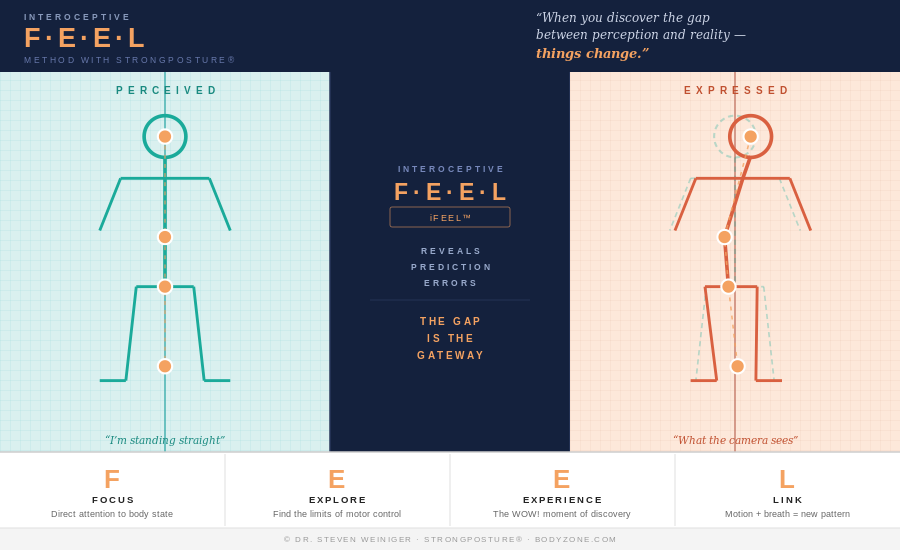
The structured experience of perceiving and thus controlling their body more accurately builds new somatic patterns — local arcs of motion initially, which are then stacked into reshaping global patterns of whole body movement towards pain-free symmetry.
The mechanism the Cholewicki model identifies — reduced unhealthy expectations and perceptions — is exactly what the iFEEL protocol addresses, through body-first means rather than cognitive talk.
The StrongPosture® BAM framework provides the motor control progression: Balance, Alignment, Motion — each step building on more accurate interoceptive awareness rather than imposed external correction. The 5 Posture Principles provide the biomechanical scaffold — the cognitive framework that gives the exercise progression continuity and meaning.
What to Do With This
The research isn’t telling you to buy new equipment or abandon your technique. It’s about changing what you pay attention to, and how you communicate — in your words and through the physicality of touch — to update the patient’s internal model of what their body is doing and can do.
What you say before you adjust, how you cue during, what you invite the patient to notice afterward — that’s not soft skill. That’s the mechanism.
That’s the shift BioBE makes possible. And the Cholewicki meta-model, with its 29 experts and 1,161 connections, points directly at it.
For continuing education on applying this framework in clinical practice:
Biomechanics & Interoception: A Biobehavioral Approach →Approved for CE hours. Designed for chiropractors, physical therapists, and NMS clinicians.
References
- Cholewicki J, et al. “A meta-model of low back pain to examine collective expert knowledge of treatment effects and their mechanisms.” European Spine Journal (2026). https://doi.org/10.1007/s00586-026-09932-y. PMID 42154226
- Nim C, et al. “The Effectiveness of Spinal Manipulative Therapy in Treating Spinal Pain Does Not Depend on the Application Procedures: A Systematic Review and Network Meta-analysis.” J Orthop Sports Phys Ther. 2025;55(2):109-122. doi: 10.2519/jospt.2025.12707. PMID 39869665
- APHA Chiropractic Health Care. “Beyond Technique: The Holistic Encounter.” Infographic citing PMID 39869665. [APHA Chiropractic Instagram, 2025–2026]