
Most rehabilitation programs tell patients what exercises to do. Very few teach them how to effectively pay attention while doing them. I’d argue that’s why so many patients plateau — or quit.
When someone performs an exercise on autopilot, they default to their dominant motor patterns. The strong muscles do the work. People avoid their weak links — the ones that actually need activation — neglected muscle and neural activation patterns stay quiet. The exercise may look right-ish from the outside, but often accomplishes little on the inside. The patient puts in effort and gets minimal return, no benefit…or possibly worsening their asymmetries.
This is why I developed the iFEEL™ Method as part of the BioBE framework. Instead of “do your best,” the instruction becomes specific and progressive: Focus on a specific region. Explore with breath control. Experience novel subtle control. Then Link that awareness into daily movement patterns. Guiding the progressive arcs of motion into chains of whole body movement.
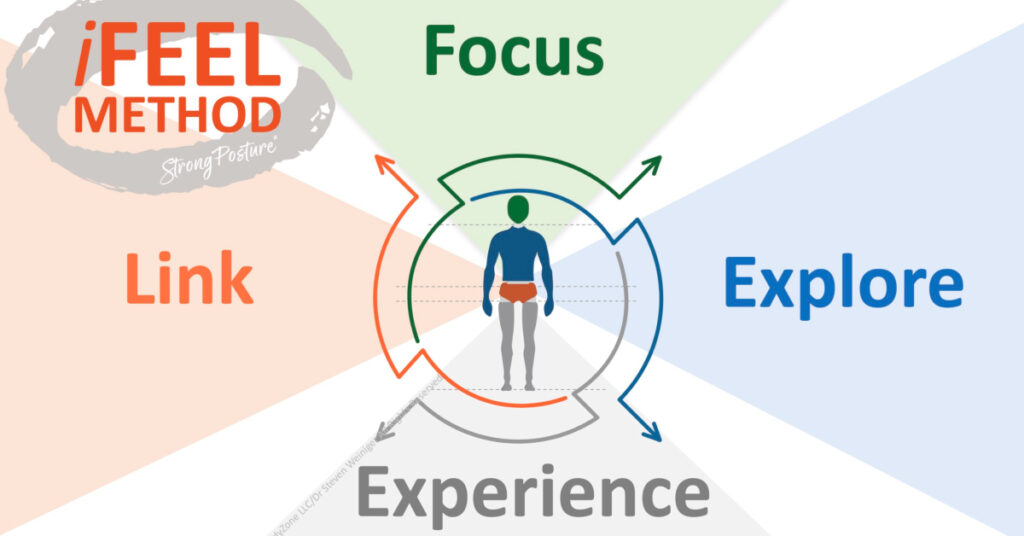
The difference isn’t the exercise. It’s the process of guiding attention. When someone learns to direct body awareness internally and move with guidance towards symmetry— to sense and perceive what’s truly happening in their body during movement — the same effort can produce a fundamentally different neurological response. Patients describe this moment in a word-“Wow!” The surprising feeling inside when something fires that hasn’t fired in years is from sensations sent to the brain along a unique part of the spinal cord. These Lamina I nerve tracts transmit messages of a hidden sense, our interoceptive sense of state, with separate and distinct processing from our proprioceptive sense of movements.
This is interoception applied to rehabilitation. It’s the clinical side of the same perception gap our IPA&A research identified — the distance between what someone thinks they’re doing and what’s mechanically occurring. Closing that gap during exercise is what turns effort into learning.
The instruction matters as much as the exercise. Maybe more.